About the Project
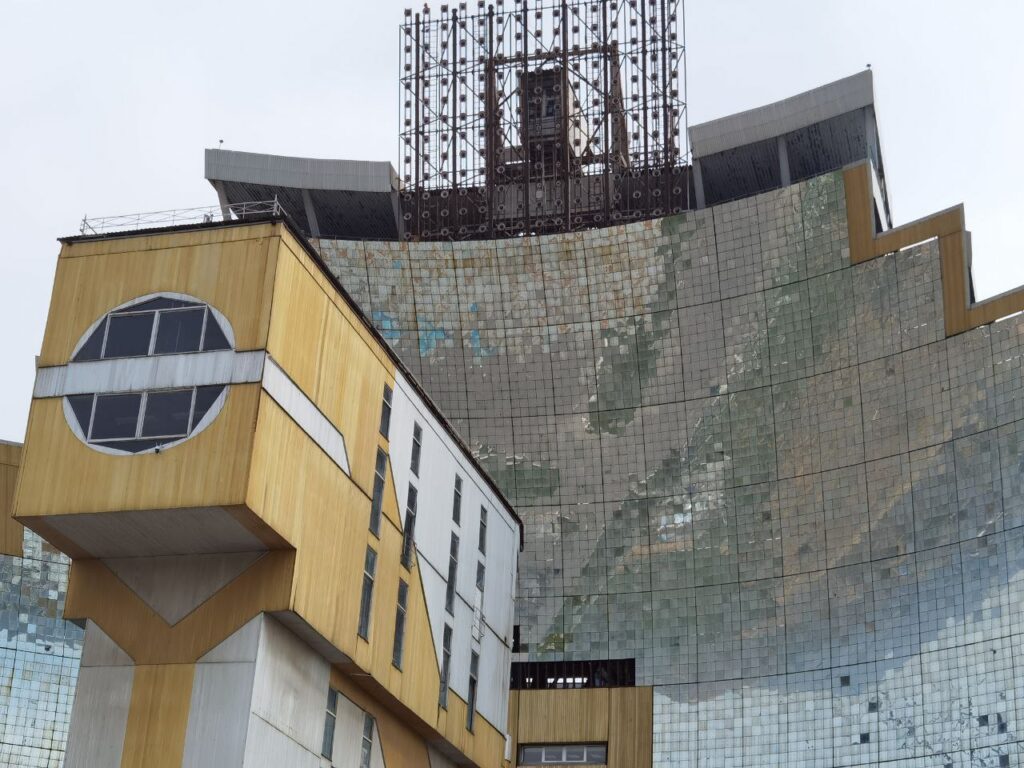
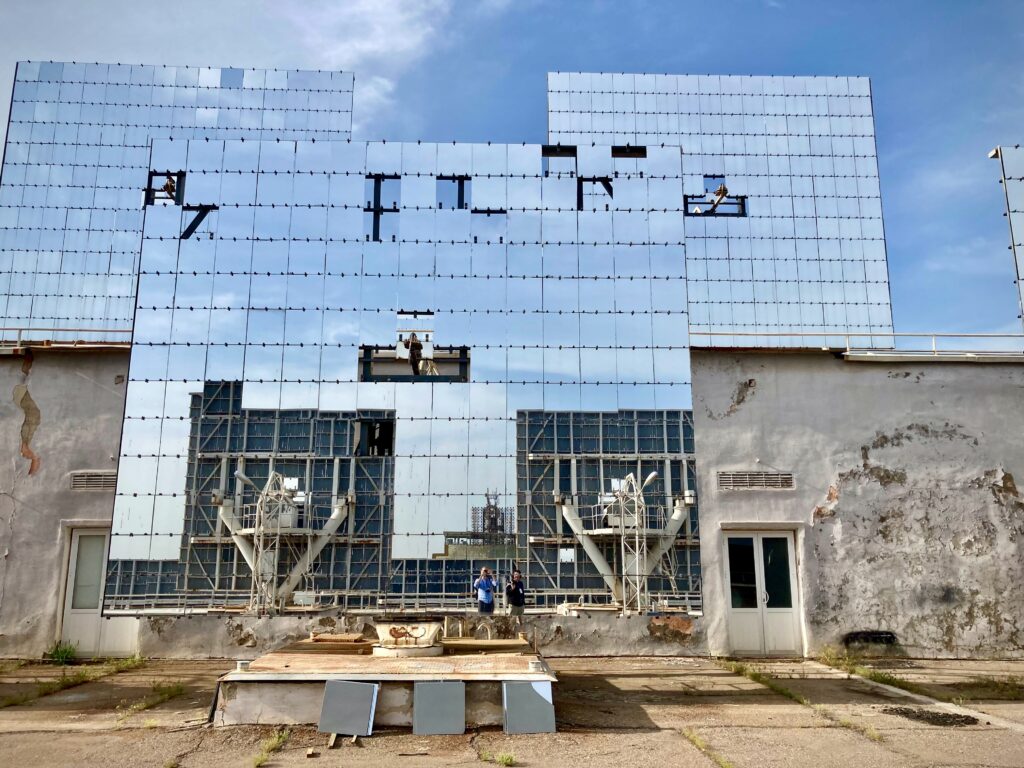
The Big Solar Furnace (BSF) near Parkent, Uzbekistan, is a monumental facility for high-temperature solar thermal research. Commissioned in 1987 and situated high in the Tien Shan mountains, it employs a vast field of computer-controlled heliostats and a towering parabolic concentrator to focus the sun’s raw power, achieving temperatures in excess of 2,500°C for pioneering work in materials science and the simulation of extreme environments.
This sonification project undertakes a profound translation: it renders the silent majesty of the BSF’s architecture and the invisible flux of its operational data into a living soundscape. Our primary artistic pursuit is to transform its physical grandeur and dynamic processes into an immersive, ever-evolving composition. It is an act of acoustic revelation, making the furnace’s monumental dialogue with the sun perceptible.
Concurrently, the work serves a vital scientific purpose. By sonifying multivariate data streams from heliostat alignment to focal point temperature, we explore sound as a medium for heightened operational awareness. This auditory layer provides the operators an intuitive channel for pattern recognition and anomaly detection, offering a complementary monitoring tool for the visual and deepening our collective understanding of complex system dynamics.
The Project seeks not only to unveil the latent harmony of this scientific and architectural marvel but to listen closely, discovering both meaning and mechanism in the voice of light itself.

Who are we

Gleb Rogoziński is a researcher, audio programmer and composer specializing in sonification, music cybernetics, and interactive soundscape design. With a doctoral thesis on Methods and Models of Cyber-Physical Systems Sonification and over a decade of academic practice, he bridges rigorous scientific methodology and creative application. An expert in the audio programming language Csound, Gleb has lectured on its creative and technical use at various institutions worldwide. He has led research projects in industrial sound design, AI-driven music systems, and acoustic ecology. His focus is on developing sonification as a tool for data interpretation, operational awareness, and aesthetic expression in complex technological environments.
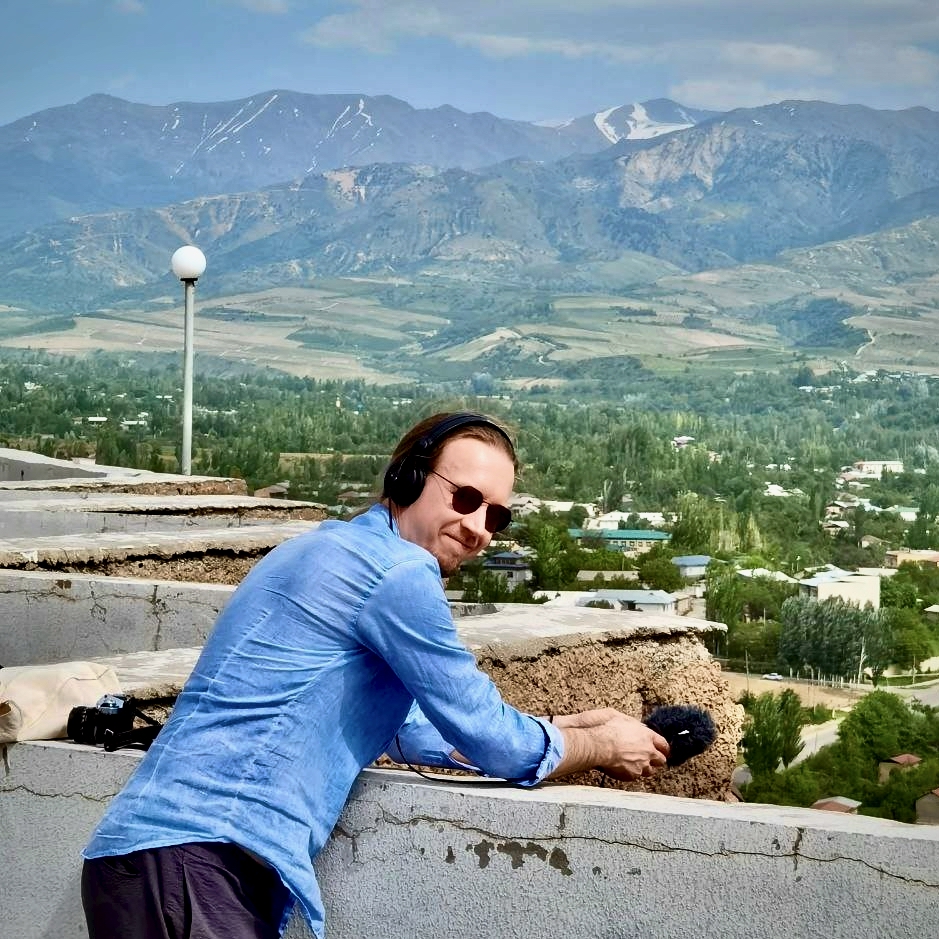
Heikki Vastiala is a sound artist, electronic musician and educator currently pursuing a master’s degree in arts at Aalto University’s Sound in New Media -programme. His artistic practice centers on creating immersive, site-specific sound installations for museums and public spaces, translating physical environments and conceptual themes into experiential auditory works. His approach combines a refined aesthetic sensibility with technical mastery, aiming to make architectural and environmental narratives perceptible through sound.
Together, we form an interdisciplinary collaboration that merges artistic depth with scientific precision, dedicated to giving meaningful auditory form to the hidden processes of our world.
Our Techniques
Our approach to sonifying the Big Solar Furnace is multi-layered, synthesizing various data sources and conceptual interpretations into a cohesive auditory experience. We employ several distinct techniques, each contributing a unique voice to the overall sound of the Project.
Architectural Resonance & Site Phonography. We treat the facility itself as a resonant instrument. By capturing the structural vibrations of the skeleton-like pillars of the main parabolic concentrator, the mechanical movements of heliostat drives, and the ambient acoustic profile of the site, we create a foundational sonic layer. These experimental recordings form a literal “music of the architecture,” grounding the work in the physical and material reality of the furnace.
Visual-to-Audio Synthesis via Csound. Translating the visual language of the facility into sound, we have developed custom synthesizers in the Csound audio programming language. These algorithms process detailed photographs of the BSF’s structural elements—the grid of mirrors, the framework geometry, patterns of light and shadow—mapping visual parameters like luminance, edge density, and spatial frequency directly to sonic parameters. This technique allows the silent, static form of the architecture to generate dynamic auditory material.
Spectral Mapping of Synthesized Materials. Drawing from the furnace’s core scientific function, we sonify the very materials it creates. We analyze the emission spectra of substances synthesized under extreme solar flux. These unique spectral signatures, representing atomic transitions at temperatures exceeding 2,500°C, are then mapped directly onto the audio domain. This creates sounds intrinsically derived from the furnace’s thermal and chemical processes, transforming scientific data into harmonic and inharmonic textures.
Process Sonification of High-Temperature Phenomena. We map real-time operational and experimental data streams into evolving sound structures. For instance, pyrometer data capturing the temperature curve of a melting sample can control granular synthesis parameters, turning a thermal profile into a dynamic sonic narrative. Similarly, heliostat alignment data or flux density distributions can be channeled into spatial audio algorithms, creating an auditory map of the system’s activity and state. This technique provides a direct, real-time acoustic representation of the furnace’s functional processes.
Audiograffiti, developed by Omni Audio Oy, is a pioneering platform for crafting interactive sound installations. This technique enables the design of dynamic, behavior-driven soundscapes that respond to the presence and movement of participants. Artists define active zones within a physical or virtual space—programmable geometric areas that trigger and modulate sound objects as recipients enter and move through them. These zones can spatialize audio in real time, apply parameter gradients, or layer sonic events, all controlled via a web-based player that interprets a participant’s position and motion. The result is a co-authored performance, where every step or pause directly shapes the auditory environment, transforming any space into a responsive, living instrument. Explore the creative possibilities with Audiograffiti.
Publications and Presentations
Gleb Rogozinski, Heikki Vastiala, Zhavohir Shermatov, Dmitry Muromtsev, Aleksandr Chudakov. Interdisciplinary Framework for Monitoring and Public Engagement at the Big Solar Furnace of Parkent. Proc. of DELCON2025, 31 Oct – 2 Nov, IEEE Delhi, 2025.
Gleb Rogozinski, Zhavohir Shermatov, and Heikki Vastiala. Sonifying the Big Solar Furnace: Bridging Science, Sustainability, and Art though Auditory Data Representation, in Proc. of Int’l Scientific Conference “New Materials and Solar Technologies”, Institute of Materials Science Uzbekistan Academy of Science, 28-30 April, Tashkent, Voris-nashriot Publishing House, 2025.
Gleb Rogozinski, Zhavohir Shermatov. Exploring Sonification for Enhanced Process Monitoring in High-Temperature Solar Furnaces, Inter’l Symposium on “Recent Trends in Emerging Technologies 4.0”, Dev Bhoomi Uttarakhand University, Dehradun, India, 22 November 2024.
Acknowledgements
We wish to express their profound gratitude to the leadership and staff of the Institute of Materials Science of the Academy of Sciences of the Republic of Uzbekistan (NGO Physics-Sun), for their invaluable support and collaboration during the field research phase of this project. We offer special thanks to Dr. Zhavohir Shermatov for his gracious guidance and for warmly facilitating our work within the extraordinary environment of the furnace facility.
Contacts
Feel free to write us and ask a question
gleb.rogozinski AT gmail DOT com
heikki.vastiala AT gmail DOT com